
 MENU
MENU


NOTE!
Click on MENU to Browse between Subjects...17CS53 - DATABASE MANAGEMENT SYSTEM
Answer Script for Module 4
Solved Previous Year Question Paper
CBCS SCHEME
DATABASE MANAGEMENT SYSTEM
DBMS
[As per Choice Based Credit System (CBCS) scheme]
(Effective from the academic year 2019 -2020)
SEMESTER - V
Subject Code 17CS53
IA Marks 40
Number of Lecture Hours/Week 04
Exam Marks 60
These Questions are being framed for helping the students in the "FINAL Exams" Only
(Remember for Internals the Question Paper is set by your respective teachers).
Questions may be repeated, just to show students how VTU can frame Questions.
- ADMIN
Define Multivalued dependency. Explain fourth normal form, with an example. (6-Marks) (7b)
4th NF - Refer 2nd Question & Answer.
Some relations have constraints that cannot be specified as functional dependencies and hence are not in violation of BCNF. To address this situation, the concept of multivalued dependency (MVD) was proposed and, based on this dependency, the fourth normal form was defined.
Multivalued dependencies are a consequence of first normal form (1NF), which disallows an attribute in a tuple to have a set of values. If more than one multivalued attribute is present, the second option of normalizing the relation introduces a multivalued dependency. Informally, whenever two independent 1:N relationships A:B and A:C are mixed in the same relation, R(A, B, C), an MVD may arise.
Definition. A multivalued dependency X → Y specified on relation schema R, where X and Y are both subsets of R, specifies the following constraint on any relation state r of R: If two tuples t1 and t2 exist in r such that t1[X] = t2[X], then two tuples t3 and t4 should also exist in r with the following properties, where we use Z to denote (R − (X ∪ Y)):
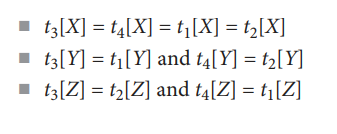
Whenever X →→ Y holds, we say that X multidetermines Y. Because of the symmetry in the definition, whenever X →→ Y holds in R, so does X →→ Z. Hence, X →→ Y implies X →→ Z and therefore it is sometimes written as X →→ Y|Z.
An MVD X →→ Y in R is called a trivial MVD if (a) Y is a subset of X, or (b) X ∪ Y = R. For example, the relation EMP_PROJECTS in Figure 14.15(b) has the trivial MVD Ename →→ Pname and the relation EMP_DEPENDENTS has the trivial MVD Ename →→ Dname. An MVD that satisfies neither (a) nor (b) is called a nontrivial MVD. A trivial MVD will hold in any relation state r of R; it is called trivial because it does not specify any significant or meaningful constraint on R
If we have a nontrivial MVD in a relation, we may have to repeat values redundantly in the tuples. In the EMP relation of Figure 14.15(a), the values 'X' and 'Y' of Pname are repeated with each value of Dname (or, by symmetry, the values 'John' and 'Anna' of Dname are repeated with each value of Pname). This redundancy is clearly undesirable. However, the EMP schema is in BCNF because no functional dependencies hold in EMP.
Therefore, we need to define a fourth normal form that is stronger than BCNF and disallows relation schemas such as EMP. Notice that relations containing nontrivial MVDs tend to be all-key relations-that is, their key is all their attributes taken together. Furthermore, it is rare that such all-key relations with a combinatorial occurrence of repeated values would be designed in practice. However, recognition of MVDs as a potential problematic dependency is essential in relational design.
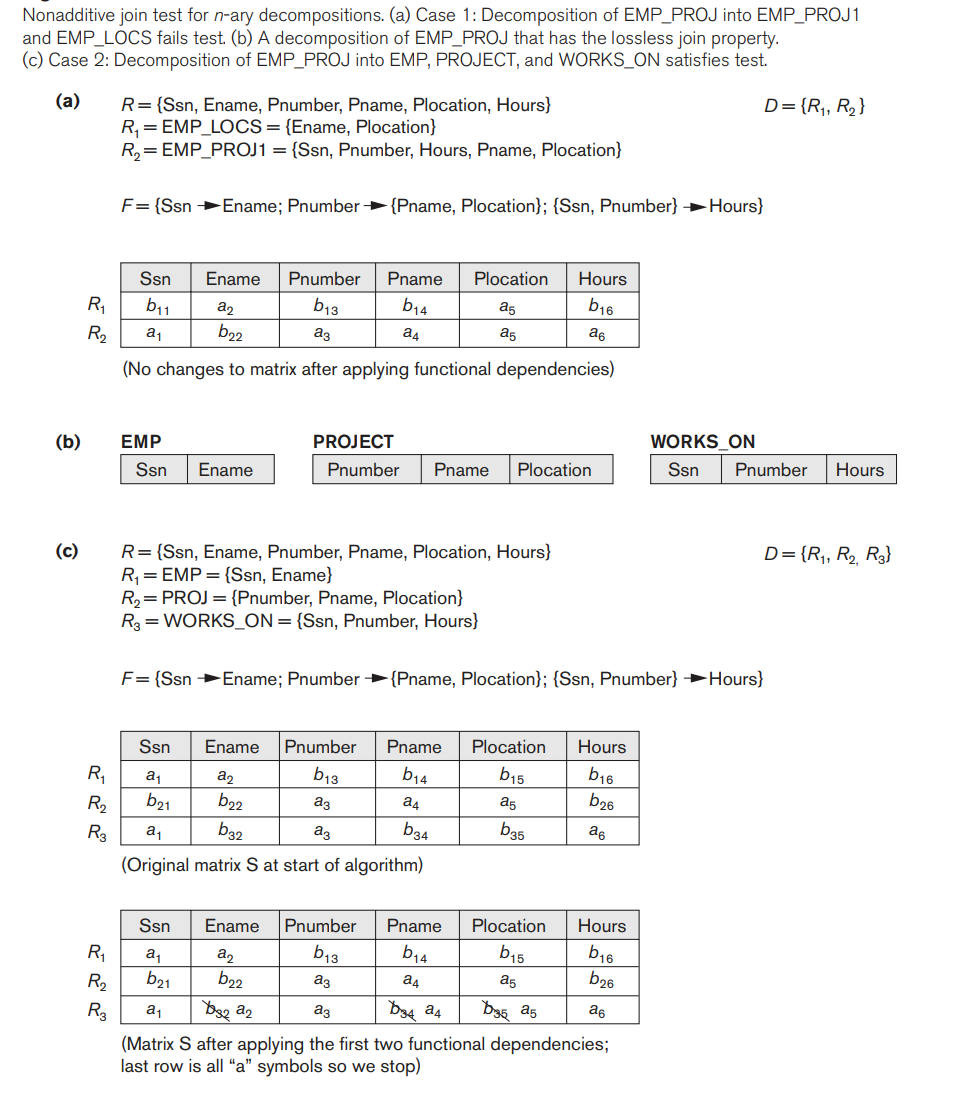
the nonadditive join property, which ensures that no spurious tuples are generated when a NATURAL JOIN operation is applied to the relations resulting from the decomposition.
Because this is a property of a decomposition of relation schemas, the condition of no spurious tuples should hold on every legal relation state-that is, every relation state that satisfies the functional dependencies in F. Hence, the lossless join property is always defined with respect to a specific set F of dependencies.

The word loss in lossless refers to loss of information, not to loss of tuples. If a decomposition does not have the lossless join property, we may get additional spurious tuples after the PROJECT (π) and NATURAL JOIN (*) operations are applied; these additional tuples represent erroneous or invalid information. We prefer the term nonadditive join because it describes the situation more accurately.
Although the term lossless join has been popular in the literature, we used the term nonadditive join in describing the NJB property. We will henceforth use the term nonadditive join, which is self-explanatory and unambiguous. The nonadditive join property ensures that no spurious tuples result after the application of PROJECT and JOIN operations.
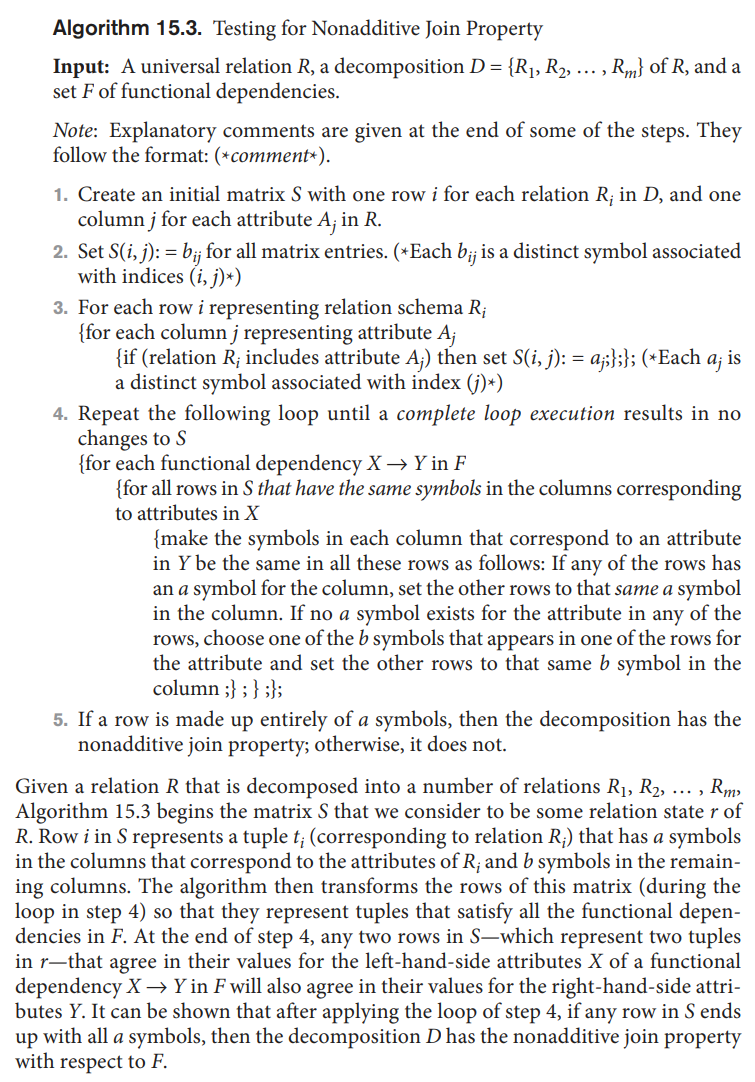
Definition. A functional dependency, denoted by X → Y, between two sets of attributes X and Y that are subsets of R specifies a constraint on the possible tuples that can form a relation state r of R. The constraint is that, for any two tuples t1 and t2 in r that have t1[X] = t2[X], they must also have t1[Y] = t2[Y].
This means that the values of the Y component of a tuple in r depend on, or are determined by, the values of the X component; alternatively, the values of the X component of a tuple uniquely (or functionally) determine the values of the Y component. We also say that there is a functional dependency from X to Y, or that Y is functionally dependent on X. The abbreviation for functional dependency is FD or f.d. The set of attributes X is called the left-hand side of the FD, and Y is called the right-hand side
Refer 3rd Question & Answer.
We must carefully consider the problems associated with NULLs when designing a relational database schema. There is no fully satisfactory relational design theory as yet that includes NULL values. One problem occurs when some tuples have NULL values for attributes that will be used to join individual relations in the decomposition.
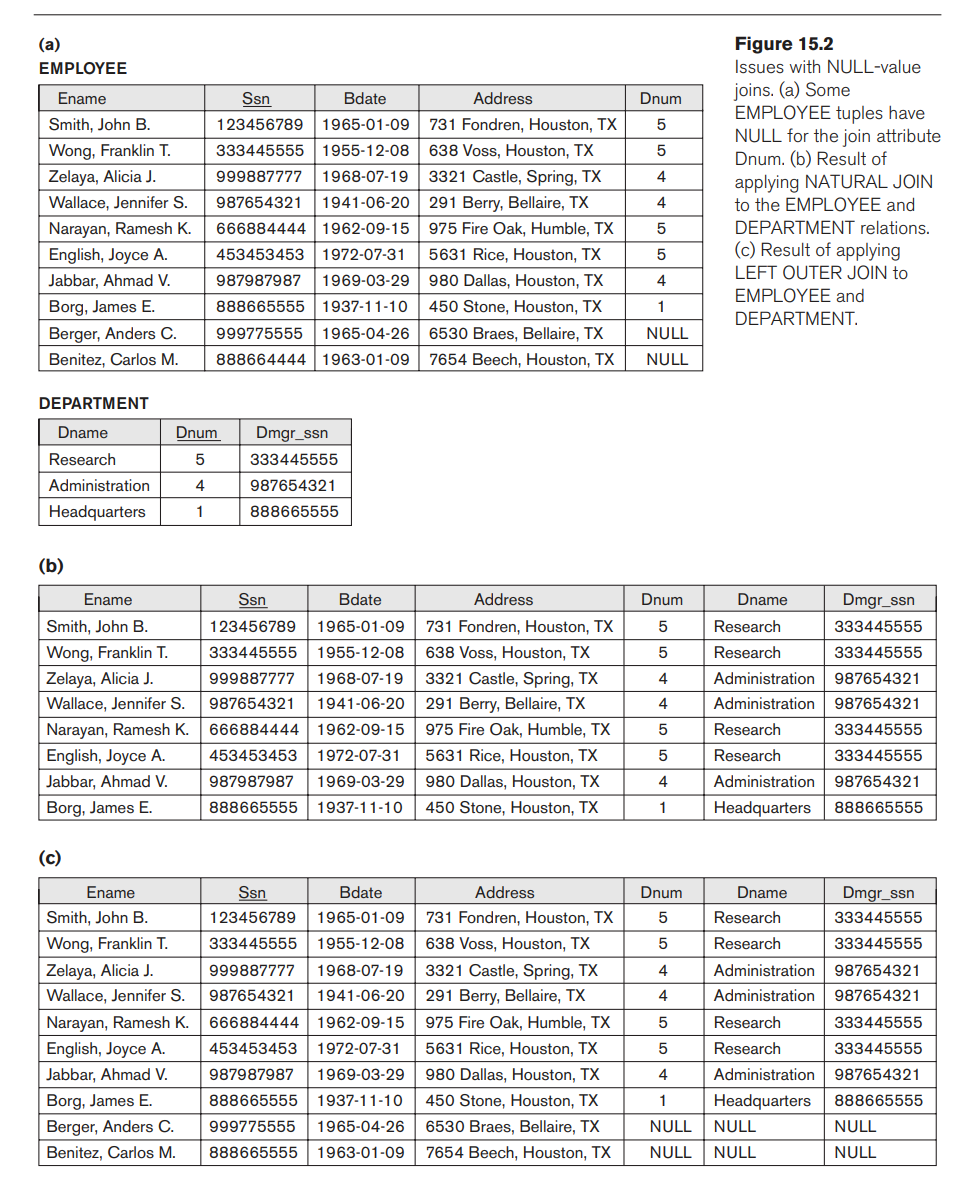
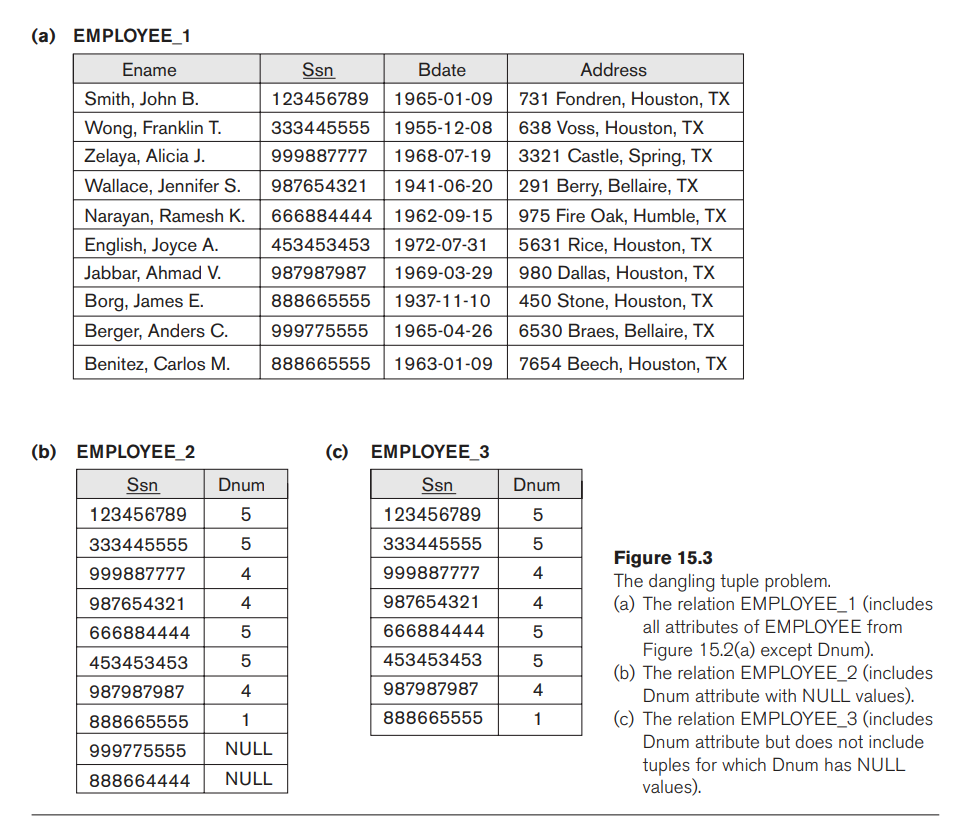
To illustrate this, consider the database shown in Figure 15.2(a), where two relations EMPLOYEE and DEPARTMENT are shown. The last two employee tuples- 'Berger' and 'Benitez'-represent newly hired employees who have not yet been assigned to a department (assume that this does not violate any integrity constraints).
Now suppose that we want to retrieve a list of (Ename, Dname) values for all the employees. If we apply the NATURAL JOIN operation on EMPLOYEE and DEPARTMENT (Figure 15.2(b)), the two aforementioned tuples will not appear in the result.
In general, whenever a relational database schema is designed in which two or more relations are interrelated via foreign keys, particular care must be devoted to watching for potential NULL values in foreign keys. This can cause unexpected loss of information in queries that involve joins on that foreign key. Moreover, if NULLs occur in other attributes, such as Salary, their effect on built-in functions such as SUM and AVERAGE must be carefully evaluated.
A related problem is that of dangling tuples, which may occur if we carry a decomposition too far. Suppose that we decompose the EMPLOYEE relation in Figure 15.2(a) further into EMPLOYEE_1 and EMPLOYEE_2, shown in Figures 15.3(a) and 15.3(b).
If we apply the NATURAL JOIN operation to EMPLOYEE_1 and EMPLOYEE_2, we get the original EMPLOYEE relation. However, we may use the alternative representation, shown in Figure 15.3(c), where we do not include a tuple in EMPLOYEE_3 if the employee has not been assigned a department (instead of including a tuple with NULL for Dnum as in EMPLOYEE_2).
If we use EMPLOYEE_3 instead of EMPLOYEE_2 and apply a NATURAL JOIN on EMPLOYEE_1 and EMPLOYEE_3, the tuples for Berger and Benitez will not appear in the result; these are called dangling tuples in EMPLOYEE_1 because they are represented in only one of the two relations that represent employees, and hence they are lost if we apply an (INNER) JOIN operation.
Below Page NAVIGATION Links are Provided...
All the Questions on Question Bank Is SOLVED
Follow our Instagram Page:
FutureVisionBIE
https://www.instagram.com/futurevisionbie/
Message: I'm Unable to Reply to all your Emails
so, You can DM me on the Instagram Page & any other Queries.